29th September 2026 | Dubai, UAE
The 7th MENA Higher Education Leadership Forum (MENA-HELF 2026) organized by the Center for Learning Innovations and Customized Knowledge Solutions (CLICKS) kicked off on 29 September at Kempinski Central Avenue Dubai, bringing together higher education leaders, policymakers, quality experts and international organisations for two days of strategic dialogue under the theme, “Global Challenges, Local Impact: Higher Education’s Role in Shaping a Resilient Future.”
The official opening followed a full day of pre-Forum workshops on 28 September, during which participants explored technology transfer, university rankings and global visibility, graduate employability and industry collaboration, and leadership development for the MENA higher education context.
The Opening Ceremony was held in the presence of Her Excellency Ohood bint Khalfan Al Roumi, UAE Minister of State for Government Development and the Future.
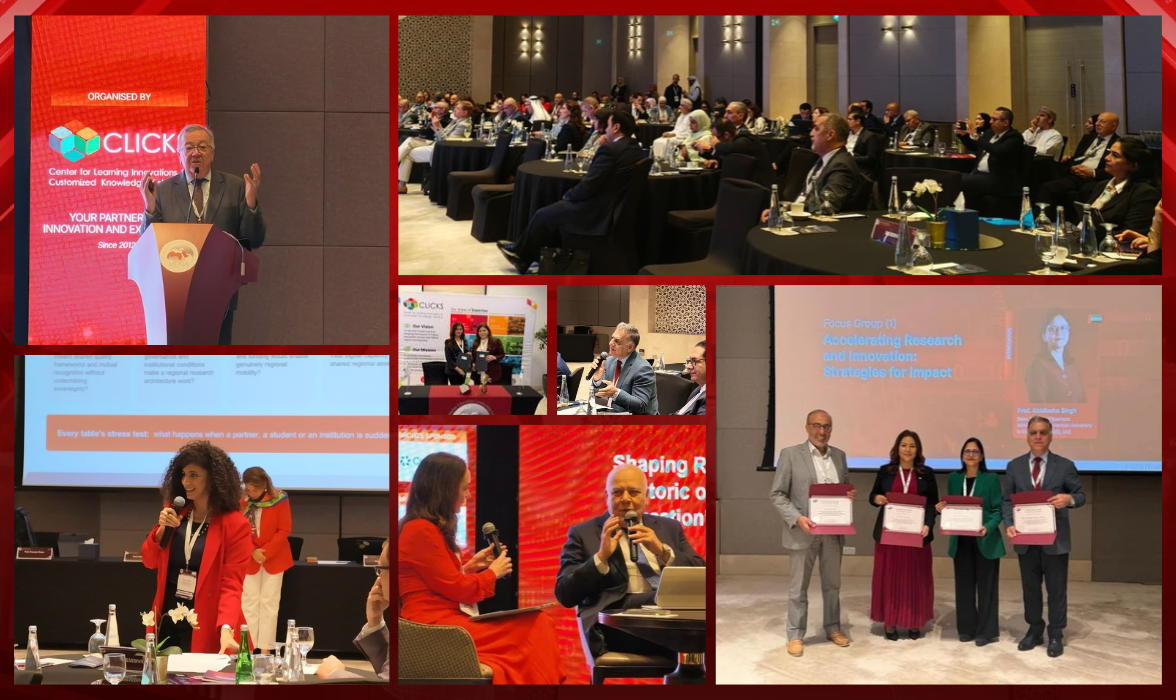
Opening the Forum, Dr Narimane Hadj-Hamou, Chair of MENA-HELF 2026 and Founder and CEO of CLICKS, reflected on the Forum’s evolution since its establishment in 2013—from a regional initiative into an internationally recognised platform connecting higher education leaders from across the world.
Her opening remarks emphasised the need to move beyond dialogue towards practical action, institutional transformation and measurable impact. She also highlighted the importance of adaptive leadership, meaningful international collaboration and the ability of universities to translate global developments into solutions that respond to their local contexts.
Prof Amr Ezzat Salama, Secretary General of the Association of Arab Universities, also addressed delegates, reinforcing the value of regional cooperation and collective leadership in strengthening higher education systems across the Arab world and beyond. The Association of Arab Universities is the Official Partner of MENA-HELF 2026.
Celebrating Institutional Excellence Across Five Continents
A major highlight of the Opening Ceremony was the announcement of the winners of the fifth cycle of the Zairi International Awards for Excellence in Higher Education.
Selected through a rigorous international assessment process from three shortlisted nominees in each category, the 2026 winners were:
Excellence in Digital Transformation: United Arab Emirates University, UAE
Outstanding Non-Profit Contribution to the Community: Modern University for Business and Science, Lebanon
Excellence in Internationalisation: Khalifa University, UAE
Excellence in Disruptive Education: Universidad San Pablo CEU, Spain
Excellence in Equity and Inclusion: Universidad Nacional de Córdoba, Argentina
No shortlisted application met the required award threshold in the Research Impact category during this cycle.
The Awards recognised institutions whose initiatives demonstrate tangible impact, innovation and a sustained commitment to advancing higher education. CLICKS also acknowledged the international assessment committee, jury members and endorsing organisations whose expertise and rigorous evaluation safeguard the integrity of the Awards.
CLICKS expressed its sincere appreciation to the partners and sponsors whose support contributed to the Forum: The Association of Arab Universities as Official Partner; the British Council as Knowledge Partner; Coursera, Turnitin and Creatrix Campus as Gold Sponsors; McGraw Hill, Studiosity and Advance HE as Silver Sponsors; and Cengage, Explorance, Taylor & Francis and EduTech as Bronze Sponsors. Appreciation was also extended to Emerald Publishing and Ajman University as Forum Supporters, and UniNewsletter as Media Partner.
Day One Connects Leadership, Employability and Institutional Impact
The opening keynote was delivered by Prof Francisco Marmolejo, Higher Education President at Qatar Foundation. In his address, “Beyond Degrees: Universities as Drivers of a Resilient Future,” he positioned resilience as a defining graduate attribute and called on universities to develop learners who can anticipate disruption, navigate complexity and contribute responsibly to society.
Dr Roberta Malee Bassett, Global Lead for Tertiary Education at the World Bank, delivered the second keynote, focusing on the need to embed vocational considerations, employability and closer engagement with employers throughout the curriculum and wider student experience.
Day One also featured two high-level panel discussions. The first examined how partnerships among universities, industry, government and civil society can strengthen workforce readiness and societal impact. A presidential panel subsequently brought together university leaders from different countries to consider how institutions can balance innovation, values and resilience while navigating geopolitical change, technological disruption and evolving workforce expectations.
The afternoon programme moved from strategic discussion to institutional practice through a series of case-study presentations. Universities from several countries shared initiatives addressing sustainability, digital transformation, artificial intelligence, employability, international engagement, leadership, governance and university–industry–government collaboration.
Day Two Broadens the Debate and Moves Towards Action
Day Two will continue with a keynote by Dr Javier Cevallos, President of the American Academic Leadership Institute, alongside a fireside chat, an Oxford-style debate, strategic panels and three Leadership Focus Groups. Discussions will address artificial intelligence, accreditation, governance, research and innovation, industry–academia partnerships, regional collaboration and the future relevance of universities. The day will conclude with a keynote by Shizuka Kato of the OECD on skills-first hiring and its implications for higher education.