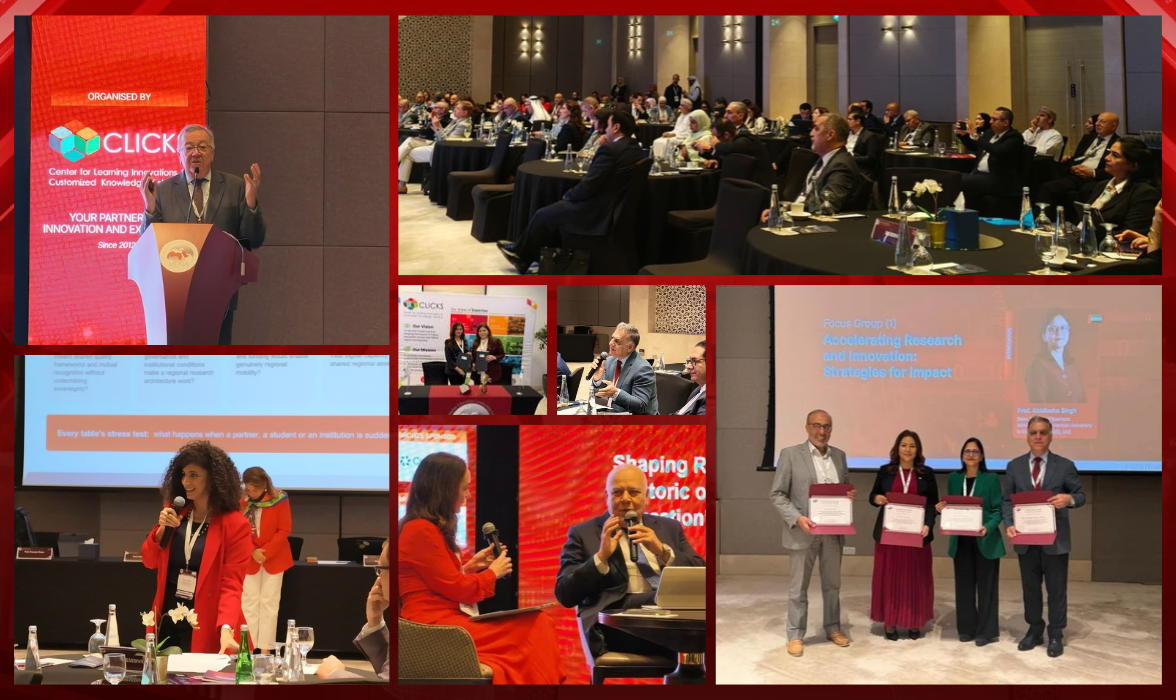
The 7th MENA Higher Education Leadership Forum (MENA-HELF 2026) concluded on 30 September at Kempinski Central Avenue Dubai, following two days of strategic dialogue on the role of higher education in building more resilient institutions, economies and societies.
Held under the theme, “Global Challenges, Local Impact: Higher Education’s Role in Shaping a Resilient Future,” the Forum brought together higher education leaders, policymakers, quality experts, industry representatives and international organisations to examine the forces reshaping the sector and identify practical responses grounded in regional and institutional contexts.
Day Two Opens with a Global Perspective
The second day opened with a keynote address by Dr Javier Cevallos, President of the American Academic Leadership Institute. In his address, “All the World is a Stage: Global Challenges, Regional Disruptions and the Future of Higher Education,” Dr Cevallos examined how demographic change, geopolitical uncertainty, artificial intelligence, shifting labour-market expectations and evolving definitions of quality are transforming higher education globally.
He emphasised that while many of the challenges confronting universities are global, institutional responses must remain context-sensitive, purpose-driven and responsive to the needs of learners, communities and society.
A fireside chat featuring H.E. Prof. Amr Ezzat Salama, Secretary General of the Association of Arab Universities, and moderated by Catriona McCarthy, Global Head of Student Mobility and Internationalisation at the British Council, examined whether universities are genuinely strengthening societal resilience or whether institutional claims of impact are moving ahead of measurable outcomes. The discussion considered how universities can define, demonstrate and strengthen their contribution to communities and society.
Challenging the Future of the Traditional University
One of the day’s most dynamic sessions was an Oxford-style debate addressing the question: “Are traditional universities becoming obsolete in the face of digital education and AI?”
Moderated by Pedro Moura, Strategic Partnerships Director at Coursera, the debate examined the growing influence of digital platforms, artificial intelligence, micro-credentials and non-traditional education providers, alongside the continuing role of universities in research, knowledge creation, social mobility and civic development.
The debate highlighted that the future of the university may be shaped less by obsolescence than by its capacity to redefine its purpose and value within a rapidly changing educational landscape.
Artificial intelligence remained central to the programme through a strategic conversation on responsible AI governance. The session explored how institutions can embrace the potential of AI while safeguarding academic integrity, educational quality and equity.
Accreditation, Governance and Future Skills
A dedicated international panel examined accreditation as a catalyst for innovation and institutional resilience. The discussion brought together representatives of quality assurance and accreditation bodies from Egypt, Iraq, Qatar, the United Kingdom, the United States and Uzbekistan.
The panel explored how accreditation can safeguard quality, equity and public trust while enabling greater institutional agility, supporting digital and hybrid learning models, and responding more effectively to changing workforce and societal needs.
The Forum’s closing panel focused on the role of governance in strengthening institutional resilience moderated by Dr Ashwin Fernandes from QS. Drawing on regional and international perspectives, panellists considered how governance models must evolve to enable responsible innovation, adaptive decision-making and more meaningful stakeholder engagement.
The final keynote was delivered by Shizuka Kato of the Organisation for Economic Co-operation and Development (OECD). Her address examined the accelerating shift towards skills-first hiring and its implications for higher education. She highlighted the importance of micro-credentials, skills intelligence and more explicit skills-based approaches to curriculum and programme design.
Moving from Discussion to Recommendations
Three Strategic Leadership Focus Groups brought together university leaders, policymakers, quality assurance professionals, industry experts and international organisations to develop recommendations in priority areas for the sector.
The groups addressed accelerating research and innovation for impact, strengthening industry–academia partnerships for local development, and advancing regional collaboration in higher education.
The recommendations emerging from these discussions will be consolidated into a series of Strategic Leadership Focus Group Reports, providing practical guidance and roadmaps for higher education leaders, policymakers and other stakeholders.
New Partnerships Formalised at the Forum
The Forum also provided a platform for formalising new institutional partnerships through the signing of a series of Memoranda of Understanding between CLICKS and participating higher education and quality assurance organisations.
Among the confirmed agreements were MoUs with the Kurdistan Accrediting Association for Education, represented by Dr Boushra Rahal Alameh; the National Quality Assurance Agency for Education of Uzbekistan President, represented by Dr Nodir Ergashev, Vice President; and Samarkand State Technical University, represented by Dr Çiğdem Canbay Türkyılmaz, Rector of the University.
The agreements were signed by Dr Narimane Hadj-Hamou on behalf of CLICKS and the respective institutional representatives. They establish a foundation for cooperation in areas including quality assurance and accreditation, institutional capacity building, leadership development, internationalisation, research and knowledge exchange. Additional agreements will be announced upon confirmation.
Reflecting on the conclusion of the Forum, Dr Narimane Hadj-Hamou, Chair of MENA-HELF 2026 and Founder and CEO of CLICKS, said: “MENA-HELF has always been about more than bringing leaders together for discussion. Its value lies in turning different perspectives into practical recommendations, stronger partnerships and commitments that continue beyond the Forum. The agreements signed and the outcomes developed over these two days reflect exactly the kind of collective action that higher education now requires.”
MENA-HELF will return in 2028 for its eighth biennial edition.